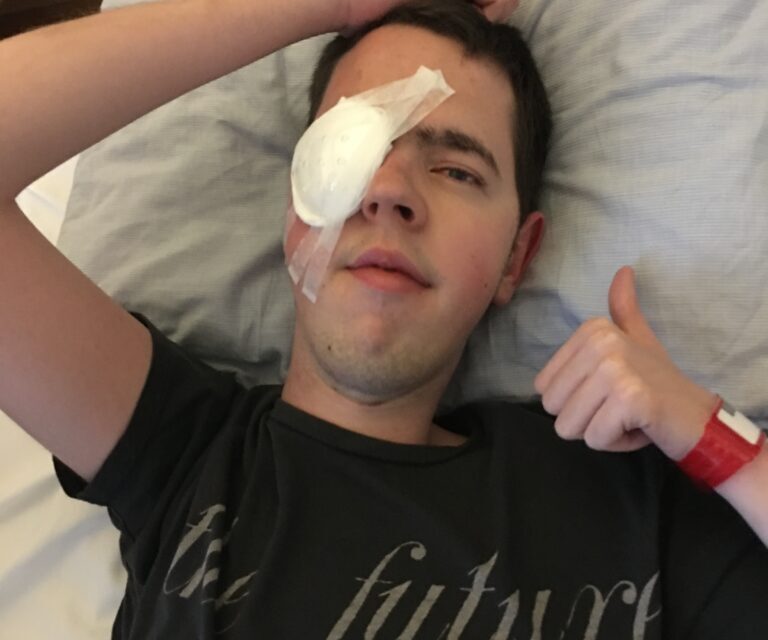
Improving Zak’s dry eye and vision…
I started to notice a decline in my general eyesight. I started having to sit closer to the TV and my computer screen, and increased the font size on my phone.
A visit to the opticians revealed that my eyes, through years of dryness, had developed a layer of corneal scarring that impaired my vision. I was referred to my local eye hospital for an appointment in which it was confirmed that there was a layer of cloudy scarring obscuring my pupils in both eyes (or medically known bi-lateral chronic exposure keratopathy with secondary subepithelial scarring). I was also told at this appointment that nothing could be done about it, despite asking about laser surgery or a corneal transplant.
Feeling dismayed by this opinion, I wasn’t prepared to accept that my vision would be poor and affect my quality of life for something so simple as a thin layer of scarring. So I researched dry eye specialists, and made a private appointment to see a consultant ophthalmic surgeon at Moorfields Eye Hospital in London for a second opinion, knowing that as a leading and globally renowned eye hospital their approach might be more cutting edge.
I was relieved that the consultant at Moorfields was much more positive that my vision would be improved. He suggested to me that a relatively simple procedure to scrape away the scarring could be performed to restore good vision and suggested that with the help of a surgical colleague any future issues with dry eye and further scarring could be reduced or even prevented. This was because I was unable to close my eye completely overnight which was contributing to dry eye.
The surgeon suggested it would help to prevent this by correcting my drooping eye (Ptosis) with surgery on the outside corners of the lids to begin with and if required, further surgery to the inner corners of the eyes. His only concern about surgery to the inner corners of the eyes would be that it would change my cosmetic appearance.
Surgeries
It was agreed that I would have three separate procedures as a first option, and further surgery for the inner corners of the eyes would be considered if I still have ongoing dry eye problems. Initially I would have lid surgery performed on both eyes, followed by the scraping (superficial keratectomy) on each eye separately, with time in between to allow for healing. These would be done approximately 2-3 months apart.
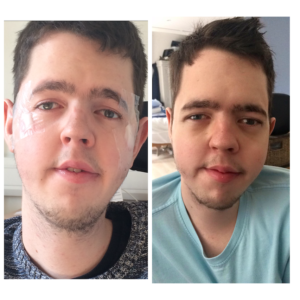 My first procedure involved cutting the muscle which pulls the lower eyelids down when you try to open your eyes wider. The bottom lids were then drawn up with a longer stitch attached at one end to each of my lower eye lids and on the other end to their respective eyebrows. These were left in place for a period of about 18 hours to prevent the lower eye lid muscles reattaching themselves again. The procedure itself took about 40 minutes and was done under a local anaesthetic. As you can imagine, several injections in and around the eyelids to numb the area made it quite painful at first but that soon eased. Afterwards my eyes were dressed and covered over with patches to protect the stitches. It wasn’t particularly nice, but listening to a couple of audio books served as a distraction. The next day, after not much sleep on only paracetamol for pain relief, the pads and then the stitches holding my lower lids up were removed. There was an immediate noticeable difference to the position of my lower lid, and I was discharged home with antibiotic tablets to recover and instructions to use regular eye drops to aid recovery. I recovered really quickly and the pain eased completely once the stitches were taken out. I also took arnica tablets which seemed to help with a faster recovery and post-surgery bruising. The surgeon was really pleased with my recovery a week later.
The second and third procedures, namely the superficial keratectomy to scrape away the scarring were done in first my left and then my right eye a few months later. We decided that it should be done first in my worst affected eye- the left eye.
Once again, I elected to have both procedures for my left and right eye done under a local anaesthetic. Each time, all that was required to numb my eye was anaesthetic eye drops. Each of the procedures lasted about 20 minutes and involved clamping the eye open, before soaking the cornea with an agent that burnt away the outer layer of the cornea- known as the epithelium- which stung a little. Then the surgeon proceeded to pick away the layer of scarring that had formed in front of the pupil. It was a bit surreal watching a scalpel near my eye and hearing the picking noise of the scar tissue being removed. After as much scarring as possible could be removed, the eyelid was injected with more local anaesthetic to prepare it for the ‘tarsorrhaphy’- or in other words stitching the eyelid closed to aid healing of the epithelium. I was advised that the eye would need to remain stitched shut for a period of 2 weeks to 2 months depending on how well it healed. I was also given regular steroid drops (dexamethosome), antibiotic drops (moxifloxacin) and was advised to maintain my routine eye lubricant regime, 1 hourly if possible during the day.
Luckily, two weeks later, I was able to have the tarsorrhaphy removed, and after a bit of readjusting to getting my eye back I realised that I was able to see so much better! This was the same for my right eye in August, and my vision is now near-perfect with glasses.
As a result of the surgery, I am now even more fastidious with my dry-eye care regime, and wear protective goggles overnight called Tranquileyes which I buy from USA. Now I also have regular eye lubrication in the form of drops (1 – 2 hourly in the day and thick eye gel at night). My consultants have said that the scarring could return again but there are always options to combat the scarring and I can have the procedures repeated if necessary, which is good news.
(Updated 2021)

Download (PDF version) Seeking Vision by Zak Hughes
For more information visit:-
Moorfields Hospital NHS resources:
https://www.moorfields.nhs.uk/condition/ptosis
https://www.moorfields.nhs.uk/content/dry-eyes
Important: Myotubular Trust hopes that this family’s personal perspective helps, but recommends you always consult with your usual healthcare team for professional medical advice, and for any specialist referral for treatments or procedures.