Outcomes of questionnaire study on symptoms in female MTM carriers
In 2020, a European study, led by Dr Nicol Voermans, Radboud University Medical Centre, The Netherlands, looked into possible symptoms of the muscles in female carriers of a myotubular myopathy (MTM) mutation. The full outcomes, published by Dr F Braun (Germany) and Dr SFI Reumers (Netherlands) et al, can be found by scrolling down this page, but firstly here is a recap of the study itself:
Who ran the study? Dr Voermans has a special interest and expertise in congenital myopathies, and the study team consists of Prof. Ulrike Schara, Essen (Germany), Prof. Heinz Jungbluth, London (UK), and Dr. Carsten Bonnemann, NIH (USA).
This study concerned all female relatives of boys/men with the X-linked form of MTM – whether symptomatic or not, including grandmothers, mothers, sisters, aunts and cousins, etc.
What were the aims of the study? The aims of this study was to find out how many female carriers have muscle complaints, how severe these complaints are and what the other most common complaints are. Also, we wanted to know what the influence of the complaints is on daily life.
How many took part? For this research, the Netherlands and Germany collaborated with the United Kingdom, and female MTM carriers from different countries were invited to participate. Ultimately, 76 women participated in the study and completed the questionnaires.
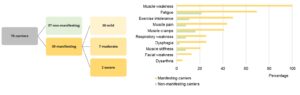
What are the outcomes to date (November 2021)? About half of the carriers had muscle weakness (also called ‘manifesting’ carriers), the other half had no muscle weakness (also called ‘non-manifesting’ carriers). The majority of the manifesting carriers could walk independently (mild), but 7 of these carriers required a walking aid (moderate), and 2 carriers required a wheelchair (severe).
In addition to muscle weakness, there was a wide variety of other muscle complaints that occurred, including: fatigue, exercise intolerance, muscle pain, and muscle cramps. These complaints occurred in both manifest and non-manifest carriers, but more often in manifest carriers. In addition, manifest carriers generally suffered more from fatigue, were less able to perform daily activities, and had a reduced physical quality of life. Pain was more frequent in the manifesting carriers, but the severity of the pain was no worse than in the non-manifest carriers.
Based on the results of this study, we can conclude that muscle complaints in female MTM carriers are more common than previously assumed. Mapping out the variation of complaints is an important step towards greater recognition and acknowledgement of these complaints in carriers. This research was performed to better understand this, and further research could provide us with even more information.
This is important to be able to provide better care, but also to allow female carriers with complaints to participate in studies into a drug for MTM.
The outcomes of this research have been published in the scientific journal ‘Neurology’. You can download a PDF copy of the paper here: Spectrum of clinical features in x-linked myotubular myopathy female carriers Reumers, Braun, et al (2021), together with a lay summary explaining the outcomes of the questionnaire female carrier study (PDF). Please scroll down to the bottom of this page to find other useful publications on female carriers of x-linked Myotubular Myopathy. The full poster presenting results at the WMS is below and can be downloaded here (PDF): Poster-Results of International Study in XLMTM Female Carriers
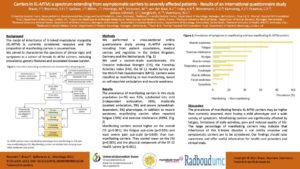


Dr. N.C. Voermans, neurologist and S.F.I. Reumers, medical student Radboudumc, Nijmegen, the Netherlands

Questions & Answers with Dr Frederik Braun, following the presentation with initial findings in January 21
On Saturday 23rd January Dr Frederik Braun from University of Essen, one of the researchers working on the x-linked carrier women’s study kindly answered some questions from our female carrier community:
Are there clinical trials for women with myotubular myopathy?
As at November 2025, there are currently no clinical trials open to females with either either MTM1 of DNM2 mutations. We hope that our research into XL-MTM carriers will help to raise awareness of the large number of symptomatic females that could also benefit from these trials and shed light on this rare disease in general.
What is ‘x-inactivation’?
From a research article by Gentilini and colleagues (2012) x-inactivation can be described like this…
“In female mammalian cells, one of the two X chromosomes is epigenetically inactivated in early embryonic life. Females are therefore a mosaic of cells with either the maternal or the paternal X chromosome inactivated (Belmont, 1996). In young women, the distribution of the two cell lines is close to normal with a mode corresponding to the 50:50 ratio. However, a marked deviation from this equivalent ratio occurs in some conditions. This event, defined as skewing of X chromosome inactivation (XCI), may be primary, due either to chance or to factors that affect the process of X inactivation during early embryo development (Minks et al., 2008), or secondary to a selection process against or in favour of cells with a specific genotype (Bolduc et al., 2008).”
What does this mean for x-linked myotubular myopathy?
As the embryo develops, cells multiply by dividing and the genes are “copied”. Epigenetics means that some factors influence whether a gene is active or not, for example if either the X chromosome from the father or mother is active or inactive. Here is where a major difference to boys lies, as they carry the father’s Y and the mother’s X chromosome.
As the female embryo grows, the cells continue to divide and differentiate, meaning they become more specific, for example muscle or bone, but they will also turn into the right or left arm and so on, all while they pass on their mode of X chromosome inactivation. The “mosaic” of cells develops, where one or the other X-chromosome is inactivated and of which the ratio in most healthy females is around 50:50. This might be one of the reasons for asymmetry.
Why do more carrier women manifest as they get older?
This mosaic of X chromosome inactivation has been shown to change with age and in some conditions this ratio becomes skewed, tilts to one side or the other (e.g. 80:20). Why that happens is not fully understood, but in some cell types this has been shown to be related to age and might be different in other cell types. Some families with XL-MTM have been examined for this and simply speaking this explanation does not work for all affected females.
Where does this leave us?
We need to find out whether there are more differences between affected boys & men and women than just the number of X chromosomes they carry. This in turn might affect whether and when they develop symptoms. What is the rate of X chromosome incactivation in different tissues (e.g. blood vs. muscle)? Measuring this in blood does unfortunately not give us any information about the muscles. What influences whether cells with the X chromosome that carries the MTM1 mutation survive or not? Questions still to be answered…
Dr. F. Braun
Studienarzt/Sub-Investigator
Universitätsklinikum Essen (AöR)
E-Mail: frederik.braun@uk-essen.de