Call for participants in an RYR1 pregnancy and bleeding online study
Researchers from King’s College London are looking for women over the age of 18 to participate in their new research study. The purpose of the project is to assess whether women with RYR1 mutations experience bleeding abnormalities and abnormalities during pregnancy and in childbirth. The study is being run jointly with the US charity, The RYR1 Foundation.
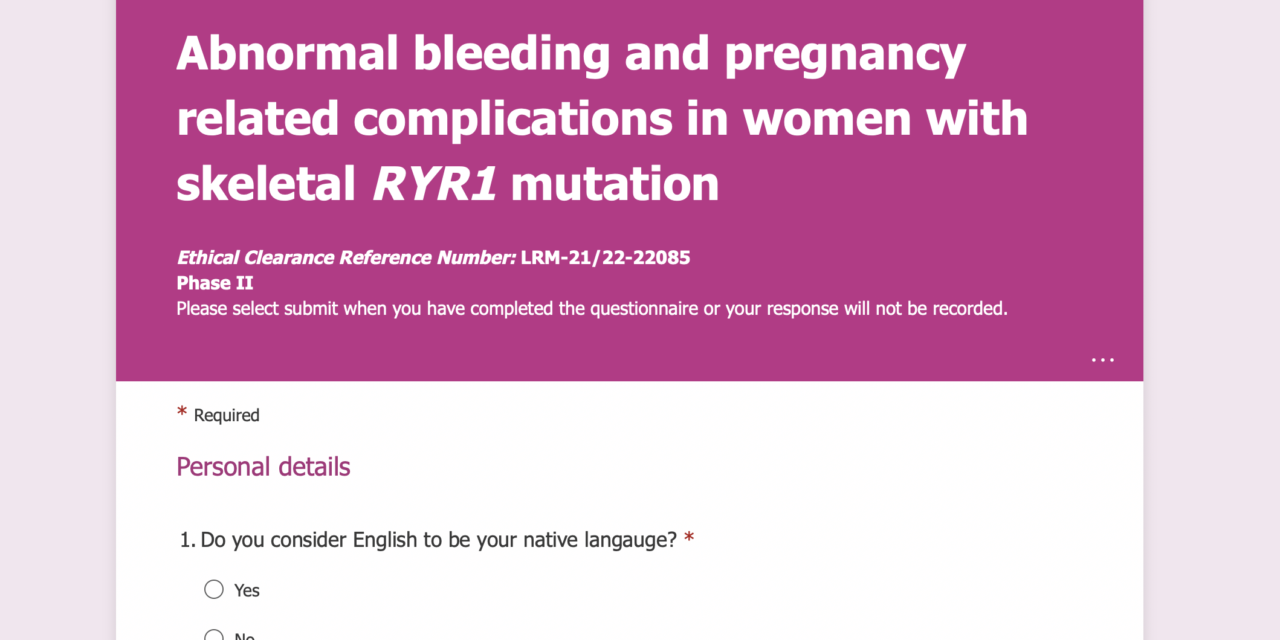
Participation in this study will involve completing a questionnaire on Microsoft Forms. This will require internet connection and should take less than 15 minutes to complete. You are being asked to participate in the second phase of the research study and your responses will be completely anonymous.
Researchers are asking individuals to complete this questionnaire for one of two reasons:
1. You are the female affected by RYR1 centronuclear myopathy, who has been in contact with our organisation, Myotubular Trust, or similar sister Centronuclear Myopathy organisations. (Or you are in contact with the RYR1 Foundation for RYR1 and related neuromuscular disorders including malignant hyperthermia susceptibility).
and/or
2. You are the female relative of someone (male or female, living or deceased) who has a RYR1 mutation and you do not have a mutation in the RYR1 gene nor any related symptoms yourself.
Please download a copy of the information sheet here (PDF)
If you wish to participate in the study, please click here to access the questionnaire.
Currently, the questionnaire is only available in English but may be translated to other languages in future.
If you have any questions, please read the information sheet, or contact Arti Mistry at arti.mistry@kcl.ac.uk.
Research Summary
This questionnaire has been developed to identify bleeding abnormalities and abnormalities related to menstruation, pregnancy or after birth. The study focuses on women with RYR1 mutation(s), with rare diseases that are normally characterised identified through a skeletal muscle phenotype. Our team and others have accumulated anecdotal (i.e. from clinical case reports Lopez et al., 2016) evidence of a secondary smooth muscle cell phenotype in women who have such mutations. This smooth muscle phenotype presents as excessive bleeding during menstruation and post-partum haemorrhage. We aim to collect data form a larger number of women in the community who have signs of a smooth muscle ‘bleeding’ phenotype. Controls will be related female family members without the condition.
Consistent with this phenomenon, we have evidence from an experimental Ryr1 mutant mouse model that vascular bleeding times are prolonged, but this can reverse by a clinically used agent, dantrolene. In our preliminary studies of pregnant mice, we are also detecting differences in uterine artery reactivity which appear to impact on fetal survival and growth.
This questionnaire could provide critical evidence to support future development of clinical research to investigate the therapeutic potential for dantrolene to tackle abnormal bleeding in women with RYR1 mutations.
Thank you for supporting this important research.