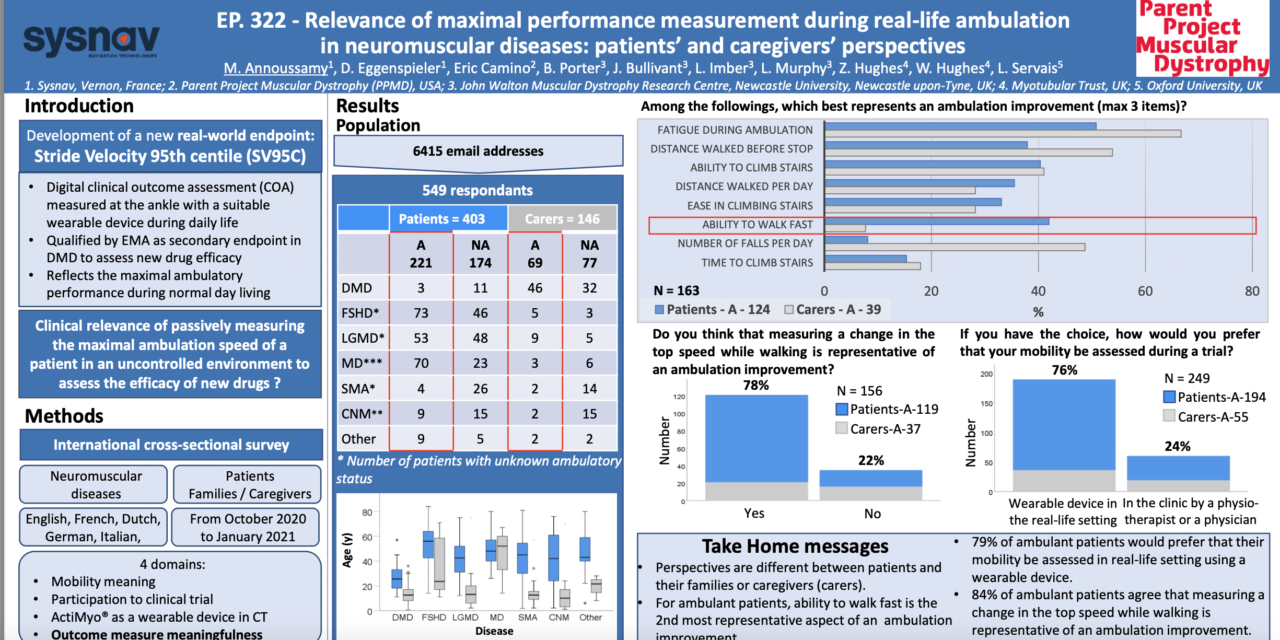
Last year a number of our patient community helped with an international survey regarding a wearable device and to help researchers identify what would represent a meaningful outcome for them in terms of muscle improvement, from a drug that works. Results of the survey have recently been published, identifying that the majority of neuromuscular patients who could walk (79%) would rather have a wearable device to measure physical improvements in their everyday life, rather than attend a clinical setting for a more formal physiotherapy assessment. The majority of carers and patients who were questioned, agreed that an improvement in ‘fatigue’ would represent the most ‘meaningful improvement’ from any drug therapy. And the second most meaningful improvement for ambulant patients (78%) was found to be the ability to walk faster than their current top speed.
 What is an ambulant patient? A patient who has the ability to walk, and who is mobile.
Mélanie Annoussamy from Sysnav kindly shares with us some of the published results which were shared at this year’s World Muscle Society Meeting:
Please download a copy of the Poster here (PDF)
Dr Mélanie Annoussamy, from Sysnav, a company specialized in the magneto-inertial technology and particularly interested in developing relevant digital clinical outcome assessments to demonstrate the efficacy of new investigational products.
Melanie explains that ‘a few years ago, we developed a new real-world digital clinical assessment called the stride velocity at the 95th centile which has been qualified in Twenty Nineteen (2019) by the European Medicine Agency as a secondary endpoint for regulatory decision making in pivotal trials in Duchenne muscular dystrophy (DMD). When measured at the ankle with a suitable wearable device, the stride velocity 95th centile reflects the maximal ambulatory performance during normal day living.
But we were wondering if passively measuring the maximal ambulation speed in an uncontrolled environment to assess the efficacy of new drug was also clinically relevant for the patients?
To answer this question, in collaboration with the American patients’ association PPMD, we designed an international on-line survey dedicated to patients with a neuromuscular disease as well as their families or their caregivers to determine their point of view about different topics including the outcome measure meaningfulness. The survey was available in English, French, Dutch, German and Italian. It was distributed by patients’ associations, including the Myotubular Trust, and reached 6415 email addresses, mostly located in UK, US, and Europe, from which we collected 549 responses.
Respondents were patients or carers of patients affected by DMD, FSHD, LGMD, myotonic dystrophy, SMA or centronuclear myopathy (MTM/CNM). For each pathology, we mainly collected answers from patients, except for DMD, where the parents answered the most, probably due to the young age of the patients.
Among the forty (40) questions of the survey, we were asking, what best represented an ambulation improvement. Participants might choose until 3 items among a list of eight. On the poster we have represented only the answers related to ambulant patients. As you can see, answers were slightly different between patients and carers.
Indeed, for the carers, the 3 items that best represented an ambulation improvement were:
1. Firstly, less fatigue during ambulation,
2. Secondly, more distance being walked before needing to stop,
3. Thirdly, a reduction in the number of falls per day.
For the patients themselves:
1. Firstly, also less fatigue during ambulation,
2. Secondly an ambulation improvement with the ability to walk faster,
3. Thirdly, was the ability to climb stairs.
Other findings included that:
78% agreed that a change in the top speed while walking is representative of an ambulation improvement;
76% would prefer that their mobility be assessed using a wearable device in the real life setting.
We asked ourselves, what was important to learn from this survey?
Firstly, we felt that the difference between patients and carers perspectives is probably important to consider when analyzing patients reported outcome measure completed by a proxy.
Then, considering only results from ambulant patients, our survey highlights that the ability to walk fast is the 2nd most representative aspect of an ambulation improvement after fatigue.
In addition, seventy-nine percent (79%) of ambulant patients would prefer that their mobility be assessed in real-life setting using a wearable device than in clinic.
And, lastly, our survey confirms that measuring a change in the top speed while walking is clinically meaningful because representative of an ambulation improvement for eighty four percent (84%) of ambulant patients.’